
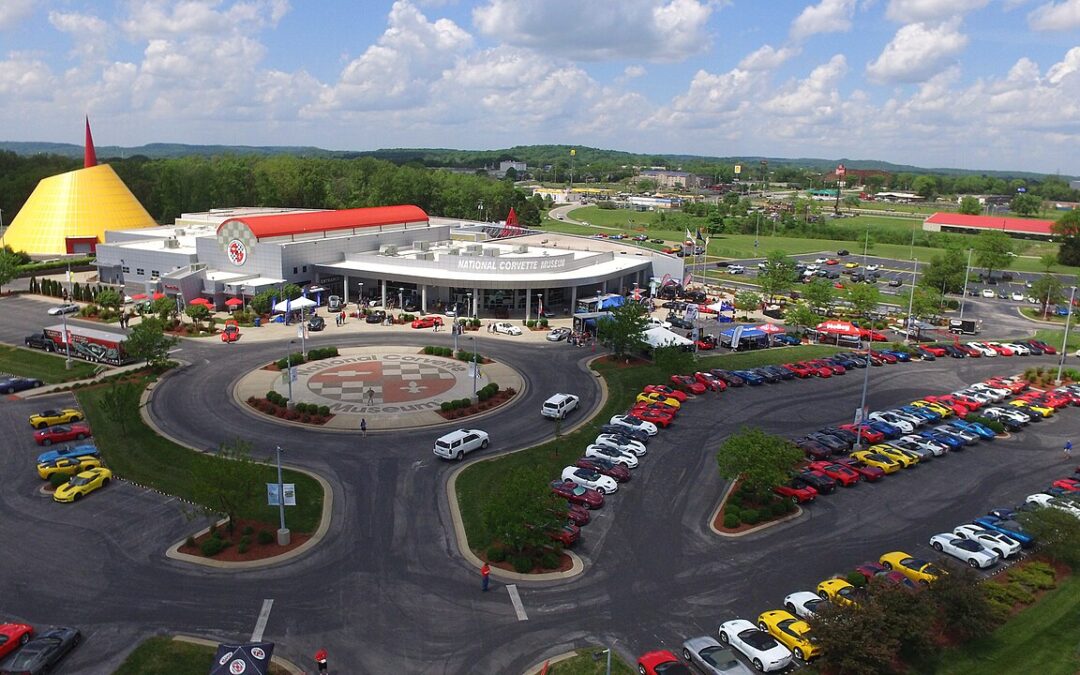
Bowling Green, Kentucky, is the only city in the United States where a single sports car is assembled from start to finish. That distinction has shaped far more than the local economy. It has influenced the region’s civic identity, its tourism infrastructure, and even public understanding of the ground the city sits on. For residents and property owners in Warren County, the story of the Corvette is inseparable from the story of the place itself.
Bowling Green’s Rise as an Automotive Manufacturing Hub
General Motors selected Bowling Green as the exclusive home of Chevrolet Corvette production in 1981, consolidating assembly at a single plant rather than splitting output across multiple facilities. The decision transformed a mid-sized college town into a nationally recognized manufacturing center. Every Corvette sold worldwide, including the current mid-engine C8 generation, still rolls off the line within Warren County.
That concentration of skilled manufacturing work drew suppliers, engineers, and support industries into the surrounding area over the following decades. Western Kentucky University, located just minutes from the assembly plant, expanded engineering and technical programs partly in response to that demand. The result is a local economy where automotive manufacturing carries a weight disproportionate to the city’s size, a pattern visible in comparable single-industry towns across the country.
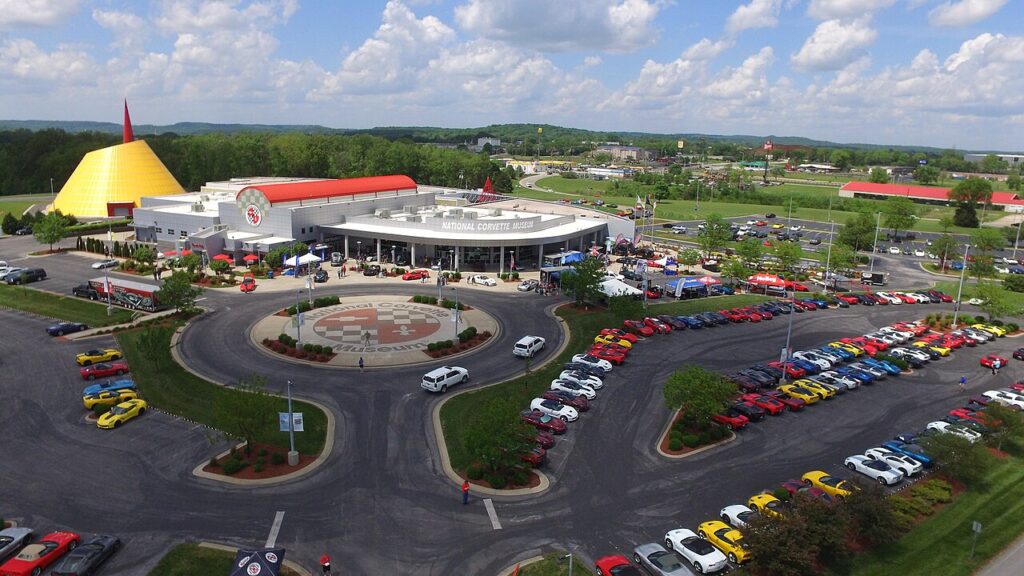
The National Corvette Museum: Preserving a Local and National Legacy
The National Corvette Museum opened in 1994 along Interstate 65, positioned deliberately near the assembly plant it celebrates. Unlike a company-run showroom, the museum operates as an independent nonprofit institution documenting the car’s full design and engineering history. Its collection spans early 1950s models through contemporary performance variants, offering a chronological record of American automotive engineering.
The museum drew international attention in February 2014, when a sinkhole opened beneath its Skydome exhibit hall overnight, swallowing eight vehicles into a cavity roughly 40 feet across. No one was present when the collapse occurred, and the museum later preserved part of the sinkhole as a permanent exhibit rather than fully repairing it. The event did more than generate headlines; it brought public attention to a geological reality that shapes construction and land use throughout the region.
Karst Geology Beneath the City: What the Sinkhole Revealed
Bowling Green sits atop extensive karst terrain, a landscape formed when groundwater slowly dissolves limestone bedrock, creating underground voids, caves, and drainage channels. This geology is common across south-central Kentucky and explains why sinkholes, rather than being rare anomalies, are a recognized risk factor in regional land development. The museum’s collapse was a dramatic example of a process that the Kentucky Geological Survey has documented extensively across the surrounding karst plain.
For property owners, karst terrain carries practical implications beyond dramatic collapses. Slow-draining soil, variable water tables, and hidden subsurface voids can affect foundation stability, grading, and long-term drainage planning on residential and commercial lots alike. Understanding this underlying geology helps explain why site assessments and proper drainage design matter more in Warren County than in areas built on more uniform bedrock.
Severe Weather and the Built Environment in Warren County
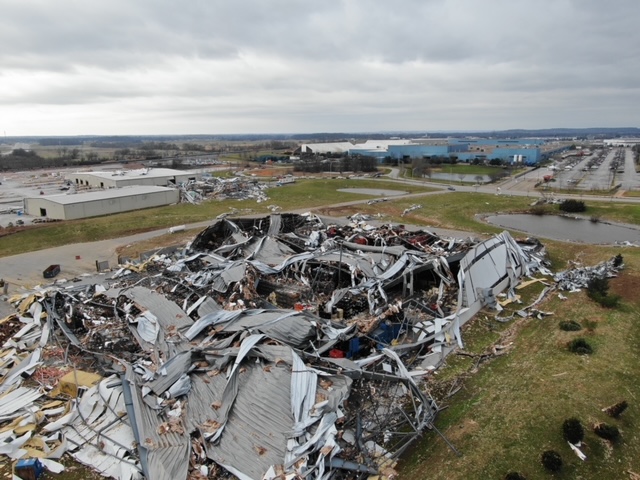
Kentucky’s location within the region meteorologists sometimes call Dixie Alley, a corridor of the Southeast known for fast-moving, often nighttime tornadoes distinct from the Great Plains’ better-known Tornado Alley, exposes Bowling Green to a tornado season that extends well beyond the traditional spring peak. On December 10 and 11, 2021, a long-track tornado family moved through western and south-central Kentucky overnight, and Bowling Green itself absorbed one of the outbreak’s most destructive strikes, with Warren County recording more fatalities than any other county affected that night. According to the National Weather Service, the tornado that struck the city’s Moss Creek and Creekwood neighborhoods reached high-end EF3 intensity, a rating on the Enhanced Fujita scale reserved for winds capable of stripping roofing systems and leveling exterior walls.
That event, alongside the region’s regular exposure to severe thunderstorms and hail, informs the wind-resistance provisions built into the Kentucky Residential Code, which is based on the International Residential Code and incorporates wind speed mapping from ASCE 7, the national engineering standard that translates a region’s storm history into minimum design wind speeds for construction. Local building officials use these standards to set minimum requirements for roof covering attachment, fastening patterns, and structural bracing on new and renovated construction. Property owners rebuilding or repairing after storm damage in Warren County are working within a code framework shaped directly by the region’s documented storm history.
A Community Shaped by Automotive Identity
Bowling Green’s civic identity now extends well past the factory floor. The city hosts the annual National Corvette Museum’s motorsports park, draws collector-car tourism from across the country, and has built a local economy where automotive heritage functions as a genuine economic asset rather than a marketing slogan. Local schools, workforce training programs, and Western Kentucky University’s engineering curriculum all reflect that orientation toward advanced manufacturing.
This dual identity, as both a manufacturing center and a geologically distinct part of the karst plain, gives Bowling Green a character that differs meaningfully from other mid-sized Kentucky cities. Residents benefit from the economic stability that a marquee industry provides, while property owners navigate the practical realities of building and maintaining structures on karst terrain in a region with a documented history of severe convective storms. Together, these threads describe a city where automotive pride and physical geography are, in their own ways, equally defining.